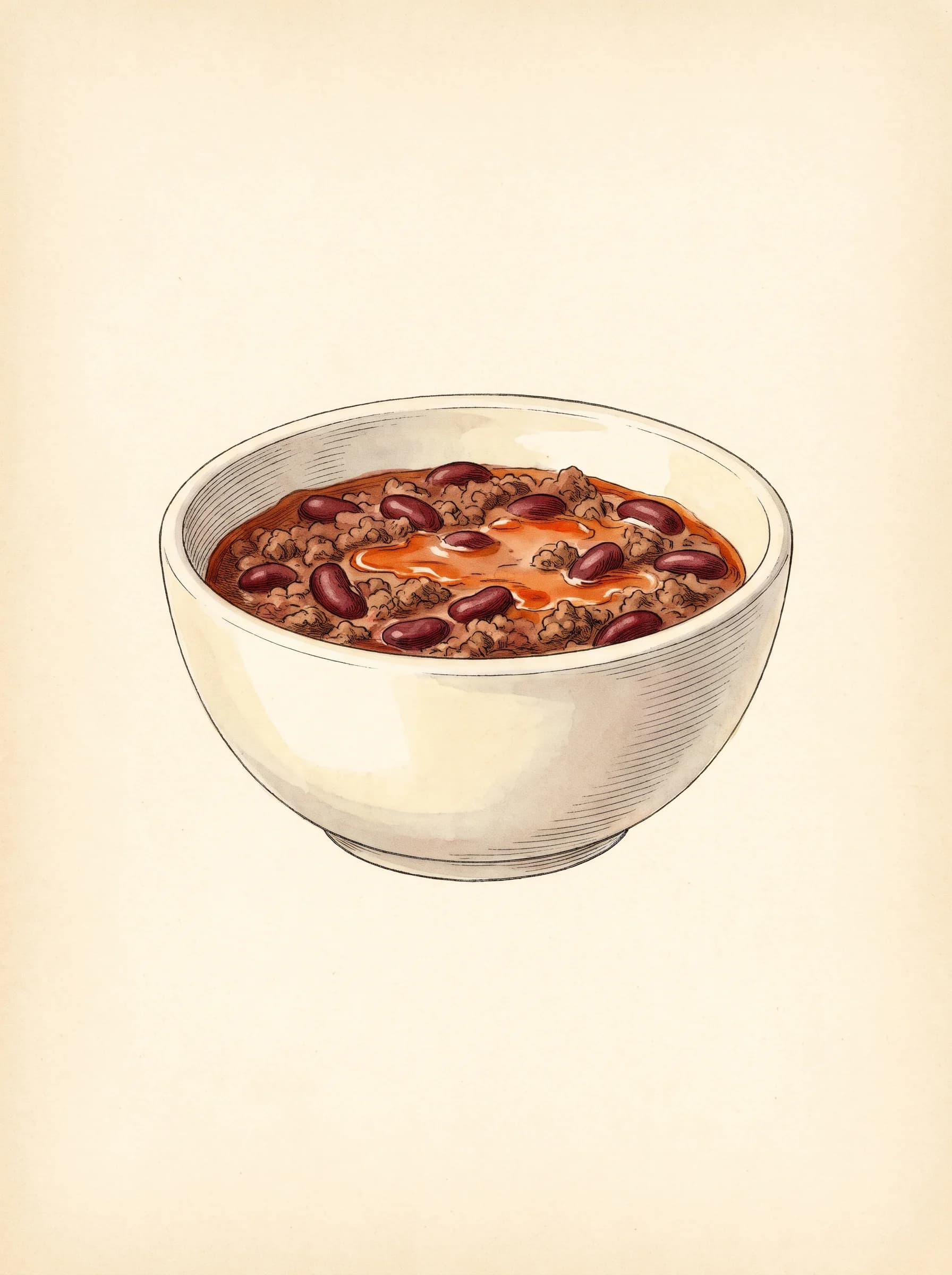
Springfield, Illinois spells it chilli, and has since at least 1909. The local style is rich and saucy, built on finely ground beef and often beef suet, with beans usually added at the counter. The city calls itself the chilli capital, and the state agreed in 1993.
Chili reached Springfield early. Packaged chili was on sale by the 1890s, and pushcart vendors sold chili and tamales downtown. Ed DeCrastos ran a cart from 1899 into the 1940s. By 1923 the city directory listed eleven chili parlors.
The double L took hold in 1909, when Joe Bockelmann and Thomas McNerney opened the Dew Chilli Parlor. The Dew seems to be the first restaurant to use it, though local historians note that prepared-chili makers used the spelling earlier. A story about Bockelmann arguing with a sign painter circulates without a primary source.
Local chilli tends to be oily, beefy and saucy, with finely ground meat and a mild spice blend heavy on cumin. Many versions use beef suet. Beans are usually cooked separately and spooned in when served. The same meat over spaghetti is chilli mac.
In 1993 the Illinois legislature honored the city. The Illinois Times quotes the proclamation as naming Springfield the Chilli Capital of the Civilized World; other accounts shorten it to Chilli Capital of the World. The local canning trade left its own trail, from Ray’s Chilli to Joe DeFrates’s Chilli Man, and DeFrates won the International Championship Chili cook-off twice.
Outsiders sometimes take the spelling for a typo.