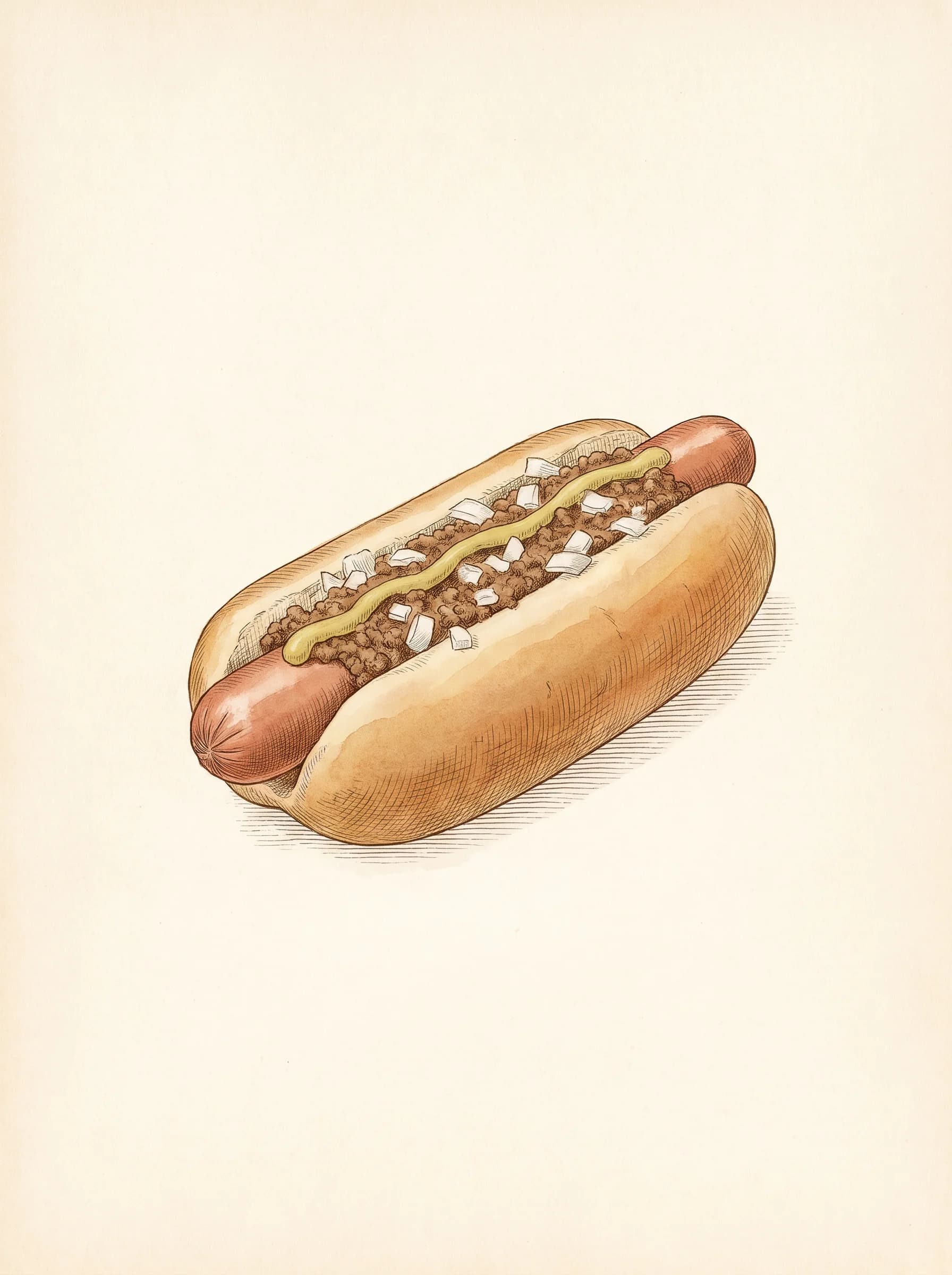
Coney sauce is a fine, beanless meat chili made to top a hot dog with mustard and onion. Greek and Macedonian immigrants built coney stands across the Midwest in the early 1900s. Michigan argues with itself over wet sauce versus dry.
Coney stands seem to have sprung up independently in several cities in the early twentieth century, many run by immigrants from Greece and Macedonia. The name probably borrows the fame of New York’s Coney Island hot dogs. Fort Wayne’s Famous Coney Island Wiener Stand opened in 1914, as did Todoroff’s in Jackson, Michigan. Kalamazoo’s Coney Island dates to 1915.
Detroit’s best-known rivalry is between two neighbors. American Coney Island was founded by Greek immigrant Constantine 'Gust' Keros, usually dated to 1917. Lafayette Coney Island opened next door; most accounts say 1924, though some give 1917 for both. The Detroit sauce is a loose, beanless chili.
Flint goes the other way. Its coney topping is dry and finely ground, built on beef heart, and many locals consider a Koegel hot dog and Angelo’s sauce essential. In Jackson, the sauce switched to ground beef heart during World War II beef rationing and stayed that way. A circulating recipe that calls for ground-up hot dogs traces to a 1978 newspaper column and was rebutted by Angelo’s in 1995.
Michigan’s standard build is a natural-casing wiener, the sauce, a stripe or two of yellow mustard and chopped onion. Other coney towns have their own: Tulsa’s dates to 1926, Duluth’s to 1921, and Houston’s James Coney Island to 1923. In Cincinnati, a coney carries Cincinnati chili.
People from Texas sometimes say coney sauce isn’t chili.