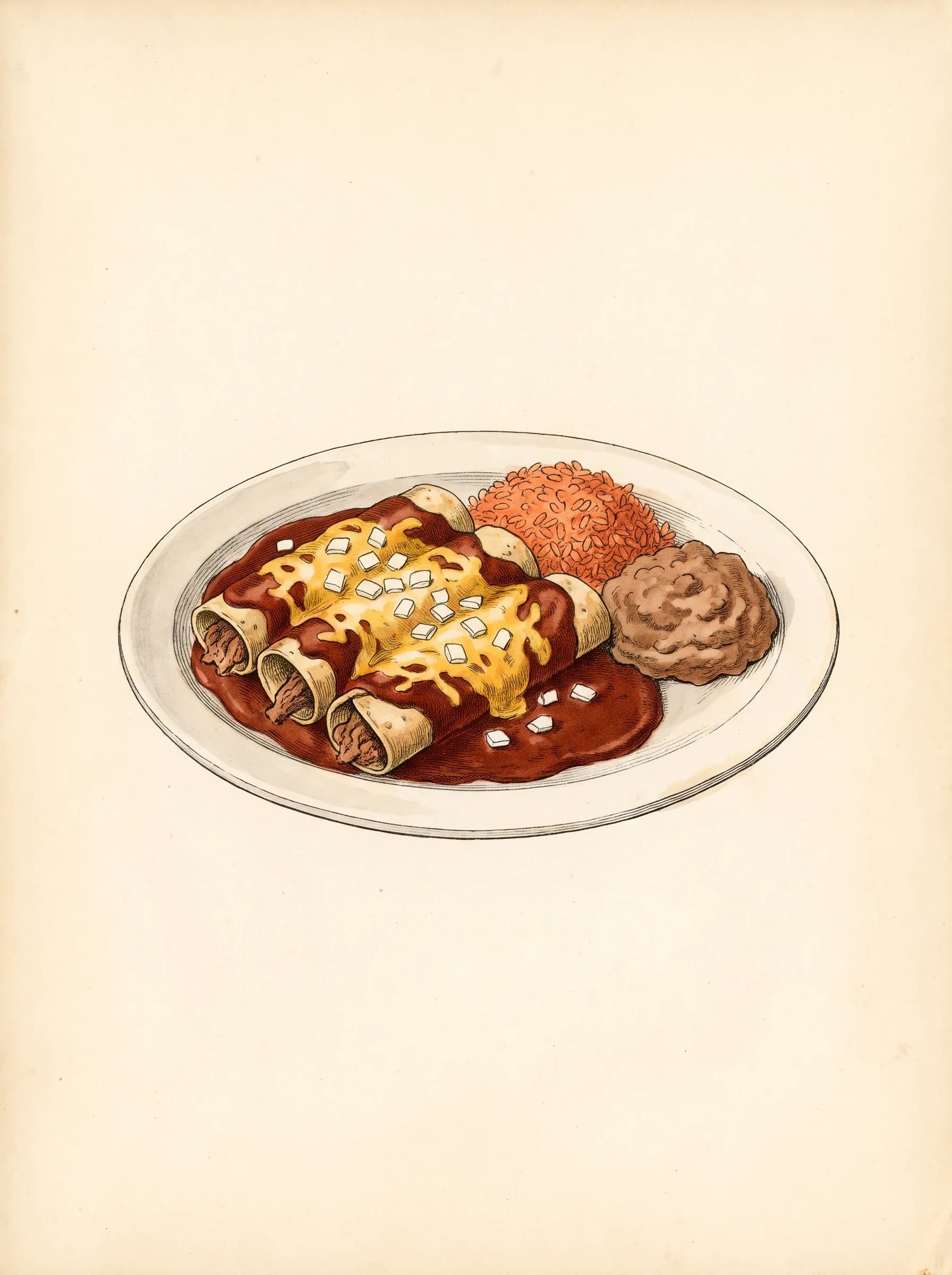
Chili gravy is the brown-red sauce on Tex-Mex enchiladas and combination plates. It is a roux of fat and flour seasoned with chili powder and cumin and loosened with broth. Robb Walsh, the historian of Tex-Mex, calls it the lifeblood of the old-fashioned cuisine.
In The Tex-Mex Cookbook (2004), Robb Walsh describes chili gravy as a cross between Anglo brown gravy and Mexican chili sauce, invented in Anglo-owned Mexican restaurants like the Original in San Antonio. The phrase is older than those restaurants. The Dallas Morning News mentioned chile gravy in May 1896, and in 1898 the San Antonio Daily Light reported a tamale vendor’s cart overturned and its chile gravy spilled.
The Original Mexican Restaurant was opened in San Antonio around 1900 by Otis M. Farnsworth, a native of Chicago. He served an entrée with rice and beans for one price, which he called the Regular, and the combination plate became a fixture of Tex-Mex. A 1940s menu lists the 'regular supper' as tamales, chili con carne, an enchilada, frijoles, corn tortillas and Spanish rice, for 45 cents. The Original stayed on Losoya Street until 1960, when Casa Rio bought it out.
In Dallas, Miguel 'Mike' Martinez, who had come from Mexico around 1911, opened the restaurant that became El Fenix in 1918, by his family’s account. By the 1930s visiting Northerners were coming for its enchiladas, though its advertising long promoted the American menu more than the Mexican. The family turned El Fenix into one of the oldest Tex-Mex chains.
The method is a roux. Lard or oil and flour cook to a light brown, chili powder, cumin, garlic and oregano go in, then broth or water, and the gravy simmers until it coats a spoon. Walsh has said older cooks used beef tallow. Some restaurants thicken with masa harina instead of flour. The gravy goes over cheese enchiladas, usually filled with processed or yellow cheese and scattered with raw onion, and over tamales on the same plate.
Chili gravy is chili con carne reduced to its sauce, and it has often outlasted the dish. Walsh wrote in 2014 that most Tex-Mex restaurants serve chili gravy on their enchiladas and many no longer make chili at all.
Sources
- Barry Popik, 'Chili Gravy (Chile Gravy),' The Big Apple
- Chris Meesey, 'On The Range: Combination Plates,' Dallas Observer (2009)
- Sarah Pruitt, 'Tracing the History of Tex-Mex,' History.com
- Jan Whitaker, 'The long life of El Fenix,' Restaurant-ing Through History (2022)
- Robb Walsh, 'Chili Americana: Landmark Chili Parlors' (2014)
- Robb Walsh, 'Nuevo Tex-Mex' (2009)
- 'A Texas helping of enchiladas, to make at home,' Seattle Times (2016)
- Chili Gravy from Robb Walsh, Food.com