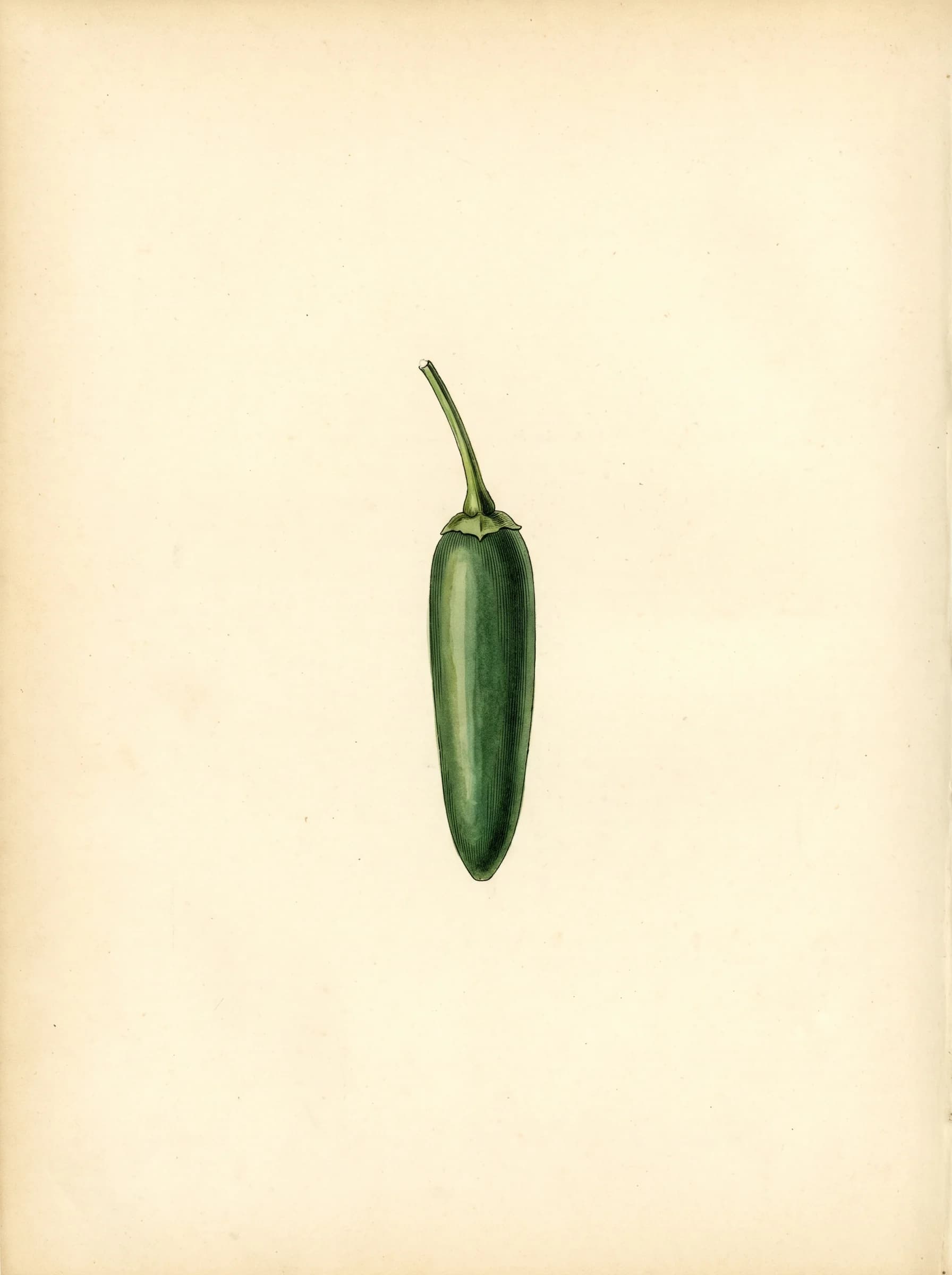
Serrano
Clean, green, and sharper than a jalapeño; University of Arizona Extension calls it the hotter of the two.
5,000 to 15,000 SHU, per Fiery Foods (DeWitt) heat scale. DeWitt’s own serrano profile gives 10,000 to 20,000, and University of Arizona Extension gives 10,000 to 23,000. Log scale against the hottest chile in this guide.
The serrano is a small, slender green chile, one to four inches long, named for the mountains of Puebla and Hidalgo where it was first grown. It is hotter than a jalapeño and is eaten almost entirely fresh. Texas chili cooks float it whole in the pot for heat.
Serrano means from the mountains. Dave DeWitt writes that the chile was first grown in the mountains of northern Puebla and Hidalgo. The pods are bluntly pointed, one to four inches long and about half an inch wide, and ripen from green to red. Mexico grows about 37,500 acres, led by Veracruz, Sinaloa, Nayarit, and Tamaulipas. DeWitt counts only about 150 acres in the United States, mostly in the Southwest.
About nine-tenths of Mexico’s crop is used fresh, most often in pico de gallo-type salsas, and Fiery Foods' glossary calls it the chile most commonly canned in Mexico. Only a small amount of red serranos is dried. In 1985 the Texas Agricultural Experiment Station released Hidalgo, a mild, virus-resistant variety that DeWitt says became popular in the United States.
Sources rank its heat differently. DeWitt’s heat scale places the serrano at 5,000 to 15,000 Scoville units, the same band as the hottest jalapeños, while his own profile of the pod gives 10,000 to 20,000. University of Arizona Extension sets it at 10,000 to 23,000.
Sources
- Pepper Profile: Serrano (Dave DeWitt, Fiery Foods & Barbecue Central)
- Glossary of Chile Pepper Terms (Fiery Foods & Barbecue Central)
- Heat Scale Updated (Dave DeWitt, Fiery Foods & Barbecue Central)
- Backyard Gardener #174: Growing Peppers and Chiles (Jeff Schalau, University of Arizona Cooperative Extension, 2024)
- Capsicums: Innovative Uses of an Ancient Crop (Paul W. Bosland, Progress in New Crops, ASHS Press, 1996; Purdue NewCROP)
- 1992 CASI Terlingua International Chili Champion recipe, Cindy Reed (CASI)
- 2013 CASI Terlingua International Chili Champion recipe, Brian Spencer (CASI)
- 2022 CASI Terlingua International Chili Champion recipe, Kris Hudspeth (CASI)
- ICS: 2003 winning recipe, Robert Dyer (Chili Verde)
- ICS: 2014 winning recipe, Mary Parker (Chili Verde)