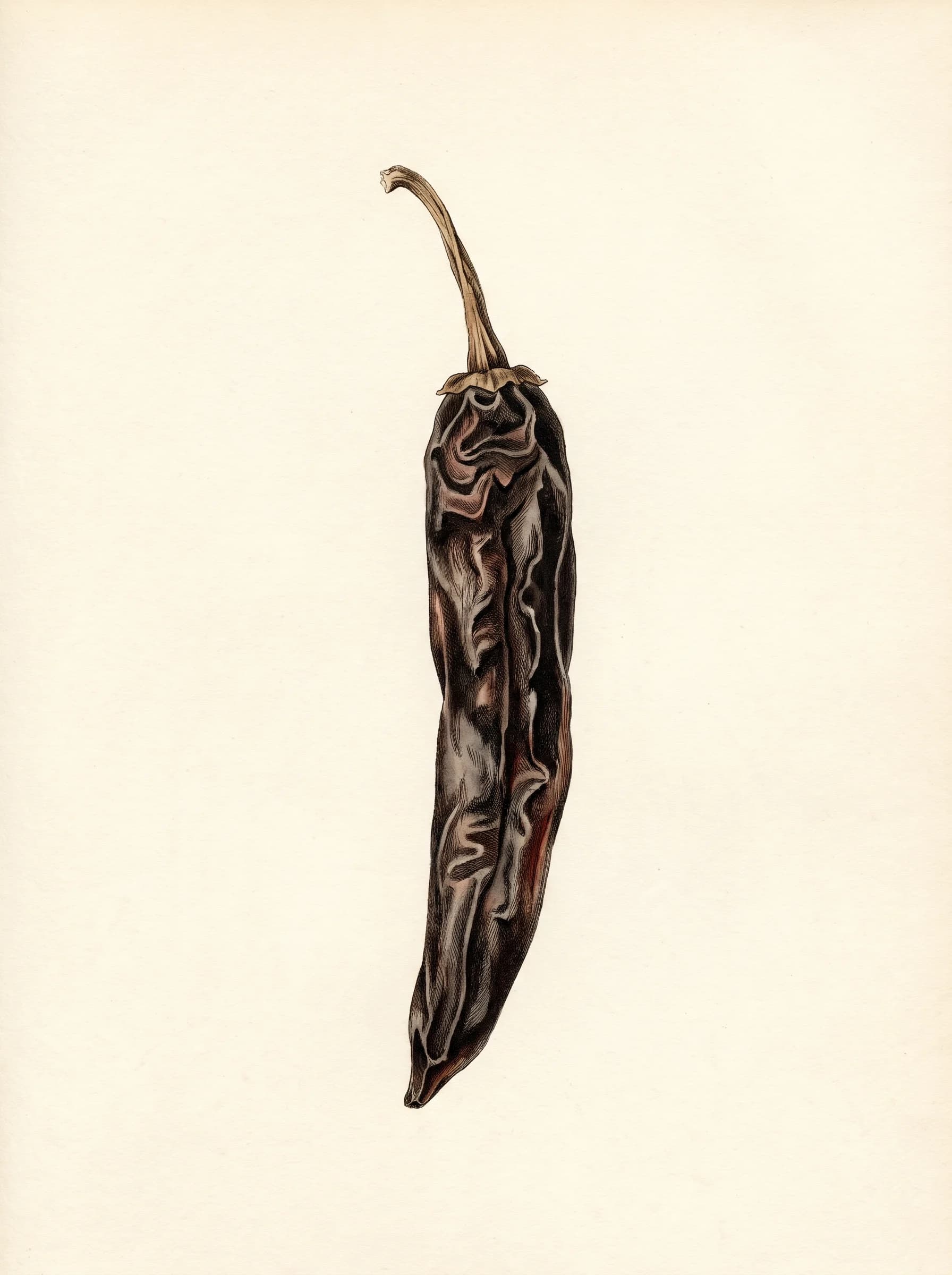
Peppers · Dried Chilaca
Pasilla
Long, thin, and dark, with overtones of chocolate and raisin, per the Fiery Foods glossary.
1,000 to 1,500 SHU, per Fiery Foods (DeWitt); Univ. of Arizona Extension agrees. Log scale against the hottest chile in this guide.
Pasilla means little raisin, for the wrinkled, nearly black pod and its dried-fruit smell. Fresh, the long green pod is called chilaca. It is mild and deeply flavored, and moleros prize it.
Mexico grows about 7,500 acres of pasillas, mostly in Aguascalientes, Jalisco, Zacatecas, and Guanajuato, by Dave DeWitt's count. The pods ripen from dark green to dark brown. DeWitt notes there is no commercial crop in the United States, and he advises home gardeners to let the pods dry on the plant.
Names here are tangled. In California and parts of northern Mexico, the ancho is often sold as pasilla, and in western Mexico pasilla is sometimes called chile negro. When a recipe asks for pasilla, check the shape: a true pasilla is long and narrow, not broad.
The pasilla may be the direct ancestor of the New Mexican chile. Fabian Garcia worked with pasilla strains when he bred New Mexico No. 9 (released 1913 by NMSU's dating; other accounts give 1917 or 1921). In the kitchen it goes into moles and adobos, and DeWitt likes it in red enchilada sauce for its taste and color.
Sources
- Pepper Profile: Pasilla (Dave DeWitt, Fiery Foods & Barbecue Central)
- Glossary of Chile Pepper Terms (Fiery Foods & Barbecue Central)
- Heat Scale Updated (Dave DeWitt, Fiery Foods & Barbecue Central)
- Backyard Gardener #174: Growing Peppers and Chiles (Jeff Schalau, University of Arizona Cooperative Extension, 2024)
- Pepper Profile: New Mexican Varieties (Dave DeWitt, Fiery Foods & Barbecue Central)