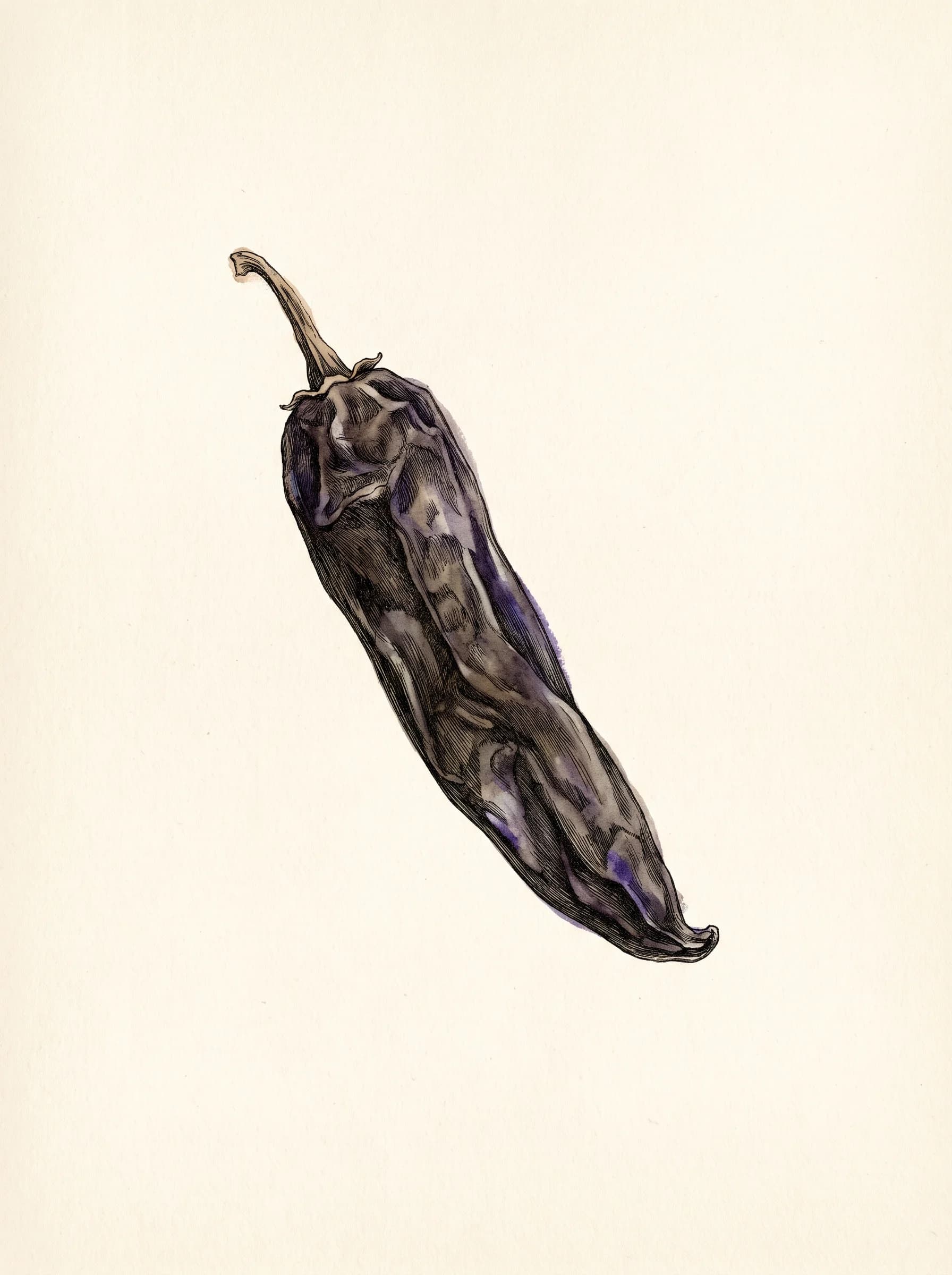
Chile Negro
As pasilla, dark and bittersweet, with the dried-fruit notes that give pasilla its name.
1,000 to 1,500 SHU, per Fiery Foods (DeWitt), for the pasilla, the pod most often sold under this name; University of Arizona Extension agrees. Log scale against the hottest chile in this guide.
Chile negro, black chile, is a market name rather than a single pod type. The sources apply it to the dried pasilla, to the darker anchos, and to a black-drying poblano grown in one town in Michoacán. All are mild, nearly black, and wrinkled.
University of Arizona Extension says the pasilla, with its dark brown pods, is sometimes called chile negro. Dave DeWitt places that usage in western Mexico and adds that the same term also refers to the darker anchos.
Fiery Foods' glossary gives a third referent. Morelia, a variety of poblano grown only in Queréndaro, Michoacán, dries to a black color and so is also known as chile negro. The glossary separately describes the mulato as a dried poblano with very dark brown, almost black pods.
The overlap compounds an older tangle. DeWitt notes that in California the ancho is sometimes sold as pasilla. A cook buying chile negro should look at the pod: a long, narrow one is a pasilla, and a broad, heart-shaped one is an ancho-type poblano.
Sources
- Backyard Gardener #174: Growing Peppers and Chiles (Jeff Schalau, University of Arizona Cooperative Extension, 2024)
- Pepper Profile: Pasilla (Dave DeWitt, Fiery Foods & Barbecue Central)
- Glossary of Chile Pepper Terms (Fiery Foods & Barbecue Central)
- Heat Scale Updated (Dave DeWitt, Fiery Foods & Barbecue Central)
- ICS: 1994 winning recipe, Bill Ray
- ICS: 2002 winning recipe, Ron Burt